
Why Is My Dog Barking at Night? A Real Fix for Exhausted Dog Owners
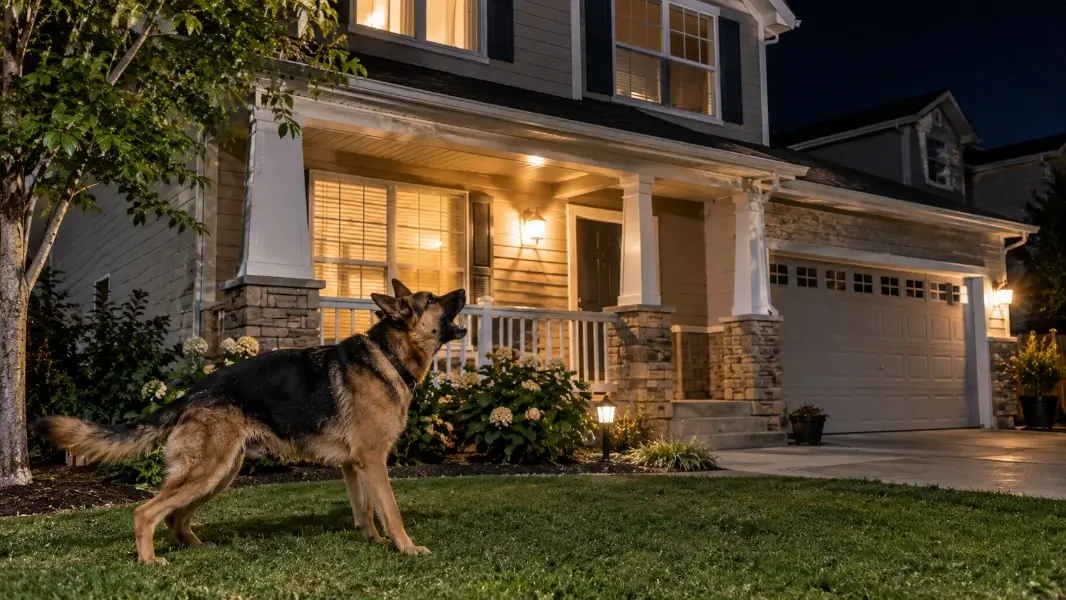
It is 3am. Your dog is barking again. You have checked everything – water bowl is full, the yard is empty, they went outside an hour ago. Nothing seems wrong. But the barking keeps going.
If this sounds like your life right now, you are not alone. This is one of the most searched dog problems in the US – and one of the least well-answered. Most guides give you the same five generic tips that do not work because they do not account for why your specific dog is barking, how old they are, or what actually happened.
This guide goes deeper. By the end, you will know what is causing your dog to bark at night, which of the six types of night barkers you have, and what actually fixes it – matched to your dog’s age and situation.
Why Dogs Bark More at Night
Dogs have much sharper senses than people. At night, the world gets quieter – which makes it easier for your dog to hear every small sound. A car door three blocks away. Raccoons moving through the backyard. The neighbor’s cat walking along the fence.
During the day, background noise drowns most of this out. At night, your dog picks up on all of it.
There is also a visual factor. Many dogs feel less secure in low light or complete darkness. Without their usual visual cues, some dogs – especially anxious or older dogs – become more alert and more reactive to sounds they would normally ignore.
A third factor is your dog’s sleep cycle. Dogs sleep in short cycles of about 45 minutes each. Around the end of each cycle, they enter a lighter sleep phase where they are easier to wake up and quicker to react. This is why many dogs bark at a consistent time every single night.
What Type of Night Barker Do You Have?
Before you try to fix anything, figure out which of these six types matches your dog. The fix is completely different for each one – and picking the wrong fix is why most advice fails.
- Alert barker – Your dog hears or sees something outside and barks to warn you. The barking is sharp, often in short bursts. Your dog faces a window or door.
- Demand barker – Your dog wants something: your attention, to come up on the bed, a treat. The barking often starts mild and gets louder. Your dog is usually looking directly at you.
- Anxiety barker – Your dog is stressed about being alone or separated from you. They may whine, pace, or bark continuously. This often starts within minutes of you going to bed.
- Fear barker – Startled awake by a sudden sound, your dog barks and stays on alert. The barking comes in bursts and then stops.
- Pain barker – Your dog wakes up because something hurts. This often sounds like a yelp or a sudden single bark. It may happen when your dog shifts position or needs to go outside urgently.
- Cognitive confusion barker – Most common in older dogs. Your dog seems disoriented, barks at walls or into empty corners, and has no clear trigger. This is a medical issue, not a behavior problem.
Why Does My Dog Bark at the Same Time Every Night?
If your dog barks at 3am like clockwork, there is a reason – and it is not random.
Dogs sleep in cycles of roughly 45 minutes. At the end of each cycle, they enter a lighter sleep phase where they are more aware of their surroundings. If your dog went to sleep at midnight, their light-sleep windows hit at 12:45am, 1:30am, 2:15am, and around 3:00am.
The 3am to 4am window also happens to be peak activity time for nocturnal wildlife. Raccoons, opossums, deer, and coyotes are most active in the hours before dawn. Your dog may be hearing or smelling these animals outside – even if you cannot see or hear anything from your bedroom.
A dog that barks at exactly the same time several nights in a row is almost certainly responding to a predictable trigger. The trigger is real. You just cannot perceive it.
What to do first: Set up a camera facing your yard or the direction your dog faces when barking. Even a cheap doorbell camera will often capture what is triggering the barking – an animal in the yard, a person walking by, headlights reflecting on the wall. Once you identify the trigger, you can address it directly.
My Dog Started Barking at Night All of a Sudden – What Changed?
Sudden nighttime barking in a dog that was previously quiet is worth taking seriously. Something changed – either in their environment or in their body.
- Something changed in the environment. New neighbors, construction nearby, a stray animal that has moved into the area, a new baby or pet in the house, or a change in your daily routine – any of these can reset your dog’s alert level at night.
- Your dog is in pain. Dogs that develop arthritis, dental pain, or a urinary tract infection (UTI) often start waking up at night. Arthritis pain is worse after lying still for several hours. A dog with a UTI may bark because they urgently need to go outside.
- Your dog is getting older. Canine Cognitive Dysfunction (CCD) – sometimes called doggie dementia – often begins showing up in dogs between 11 and 15 years old. Night barking is one of the most common early signs.
- Your dog is a rescue or recently moved. Dogs need three to eight weeks to feel safe in a new home. Night barking during this adjustment period is very common and usually resolves on its own as your dog settles in.
- Your dog had a scary experience. A thunderstorm, fireworks, a dog attack, or something that spooked them on an evening walk can trigger new nighttime anxiety.
If the barking started suddenly and you cannot identify an environmental cause, a vet visit should come before any behavior work begins.
Puppy Barking at Night – What Is Normal and What Is Not
Puppies between 8 and 16 weeks old will almost always bark or whine at night when first crated. This is completely normal. They were sleeping in a pile with their littermates. Being alone in a dark room is a genuinely strange and scary situation for them.
A few things that actually help:
- Place a worn t-shirt that smells like you inside the crate
- Use a Snuggle Puppy (a stuffed toy with a heartbeat simulator) or a warm water bottle wrapped in a blanket to simulate body warmth
- Place the crate in your bedroom for the first two to four weeks, then move it gradually
- Take your puppy outside to go to the bathroom every three to four hours for the first several weeks – a full bladder will cause barking no matter what else you do
Puppies between 4 and 6 months may hit a fear imprint period where new sounds suddenly feel threatening. Some puppies that were sleeping fine start barking again at this age. It usually passes within a few weeks if you do not make a big deal of it.
The goal with puppies is to meet their actual needs rather than trying to train barking away before they are developmentally ready.
Senior Dog Barking at Night – When It Is More Than a Habit
This is the most important section for anyone with an older dog.
Senior dog nighttime barking is often dismissed as attention-seeking or stubbornness. In many cases, it is not. It is a symptom of something physical or neurological – and treating it like a behavior problem wastes time and makes things worse.
Canine Cognitive Dysfunction (CCD)
Canine Cognitive Dysfunction is a degenerative brain condition in older dogs – similar in many ways to Alzheimer’s disease in humans. It affects memory, awareness, and sleep-wake cycles.
The ASPCA estimates that more than 50% of dogs over 11 years old show at least one sign of CCD. By age 15, it may affect nearly all dogs to some degree.
Common signs of CCD that show up at night:
- Barking at walls, corners, or empty rooms with no visible trigger
- Looking disoriented or confused when they wake up
- Getting stuck in corners or behind furniture
- Pacing repeatedly without settling
- Waking up and acting like they do not recognize their sleeping area
- Increased anxiety and restlessness around dusk – called sundowning, the same pattern seen in human dementia patients
CCD is not curable, but it is manageable. A vet can prescribe selegiline, the most commonly used medication in the US for this condition. Melatonin and omega-3 fatty acid supplements have shown benefit in published research. Diet changes with antioxidant-rich ingredients may also slow progression.
If your senior dog is barking at night, do not try to train this away without first talking to your vet about CCD. No amount of behavior training will fix a neurological condition.
Arthritis and Joint Pain
Arthritis is very common in older dogs and gets worse at night. When a dog lies still for several hours, joints stiffen. Shifting position can cause sharp pain, which wakes them up and may cause barking or whining.
Signs that point toward pain: barking that starts after lying down for a while, barking connected to movement or position changes, the dog being stiff when they first get up in the morning.
A vet can confirm arthritis with a physical exam and may recommend anti-inflammatory medication, joint supplements like glucosamine and chondroitin, or an orthopedic dog bed to reduce pressure on sore joints.
Other Medical Causes in Senior Dogs
- UTI (urinary tract infection) – Urgency and discomfort at night; your dog may also be drinking more water than usual
- Hypothyroidism – Can cause restlessness and behavioral changes in dogs
- Cushing’s disease – Causes increased anxiety and nighttime restlessness
- Hearing loss – Dogs that lose hearing become more anxious because they can no longer interpret their environment accurately. Sounds that were once identifiable become startling and confusing.
- Vision loss – Low light becomes much more disorienting as vision declines. Dogs with cataracts or other eye conditions may be much more anxious at night than during the day.
Any sudden nighttime barking in a dog over 7 years old deserves a vet visit before any behavior training begins.
How to Stop Dog Barking at Night – Matched to the Cause
There is no single fix that works for every dog. The solution depends on the type of barking you identified earlier.
For Alert Barkers
The goal is to reduce the stimulation reaching your dog – not to teach them that barking is wrong. Alert barking is instinctive. It is not disobedience.
- White noise machine – Place one near your dog’s sleeping area to mask the small sounds that trigger barking. Brown noise (deeper than white noise) is often more effective for sound masking.
- Blackout curtains or frosted window film – Removes the visual trigger when your dog barks at shadows or passing lights on the ceiling.
- Move the sleeping spot – If your dog sleeps near a window or exterior wall, moving their bed to an interior room removes the stimulation entirely.
- Baby gate to limit patrol zone – Some dogs move from window to window at night. A gate that keeps them in one room removes this trigger loop completely.
For Demand Barkers
Demand barking follows one rule: attention must never follow barking. Not even negative attention. Not even going in to tell your dog to be quiet.
When you go in at 2am and tell your dog to stop, you have just rewarded the barking. Every response – even a frustrated one – makes the behavior stronger over time.
The pattern that follows when you stop responding is called an extinction burst. The barking will get louder and more frequent before it gets better. This is completely predictable and normal. Most people give in during this phase, which makes the problem significantly harder to fix going forward.
The practical fix: build a solid “quiet” cue and a “place” command during the day, when you are not sleep-deprived and your dog is calm. Use those cues consistently at night. Reward quiet behavior rather than reacting to the noise.
For Anxiety Barkers
For dogs with mild separation anxiety at night:
- Adaptil (Dog Appeasing Pheromone) diffuser – Plug one in near your dog’s sleeping area. The AVSAB (American Veterinary Society of Animal Behavior) recognizes pheromone therapy as a supported adjunct to behavior modification.
- Melatonin – Can help reduce nighttime anxiety. Typical starting doses: 1mg for dogs under 10 lbs, 1.5mg for 10 to 25 lbs, 3mg for 26 to 100 lbs, and 5mg for dogs over 100 lbs. Always confirm the dose with your vet first. Never use formulas containing xylitol, which is toxic to dogs.
- For moderate to severe anxiety – Medication from a vet or veterinary behaviorist (DACVB) is often necessary. This is not a problem you can train away without also addressing the underlying anxiety.
For more on managing separation anxiety and other behavioral triggers, our guide on understanding why dogs bark and how to address each type covers those approaches in depth.
Setting Up Your Dog’s Sleep Environment Properly
Most guides skip this section entirely. The environment your dog sleeps in has a large effect on how much they bark at night – and getting this right can reduce barking significantly without any training at all.
- Temperature – Dogs sleep best between 65 and 75 degrees Fahrenheit. A dog that is too hot or too cold will be restless and much more likely to bark.
- Noise level – Total silence is not ideal for most dogs. A completely quiet house amplifies every small sound. A white noise machine or a fan running nearby provides consistent background sound that masks small triggers.
- Light – Complete darkness is better for most dogs than ambient light from street lights, hallway lights, or electronics. Blackout curtains in your dog’s sleeping room can make a real difference.
- Crate setup – If your dog sleeps in a crate, covering three sides with a blanket (leaving the front open for air) creates a den-like feeling that many dogs find more secure. Keep the crate away from high-traffic areas of the house.
- Bedding – An orthopedic dog bed with memory foam significantly reduces nighttime movement and discomfort in older dogs with joint pain. This is worth the investment for any dog over 6 years old.
- Pre-bed routine – A 15 to 20 minute walk or play session before bed burns off energy. A frozen Kong or lick mat given 30 minutes before sleep gives your dog a calming pre-sleep activity. These two habits together reduce the mental restlessness that leads to nighttime waking in many dogs.
Still Barking After Trying Everything? Here Is What to Do Next
This section is for the owner who has read three articles, tried the advice, and is still up at 3am six weeks later.
The most common reason “everything” fails is that the wrong fix is being applied to the wrong type of barking. If your dog has CCD and you have been following demand barking protocols, nothing will improve – because CCD is not a behavior problem.
- Get a camera assessment. Set up a camera facing where your dog sleeps for three nights. Watch the footage. You may catch a stimulus you had no idea about – an animal under the porch, a sound from a neighbor’s house that travels at a specific time, a reflection pattern on the wall from passing cars.
- Keep a barking log. Write down the exact time it starts, what preceded it, and what ended it. After five nights, patterns become visible that you would not notice in the moment.
- Rule out pain and medical causes. Ask your vet for a full physical exam with specific attention to joints and urinary health. Tell them the barking is new or getting worse. Be specific about when it happens.
- Consult a certified professional. A CPDT-KA (Certified Professional Dog Trainer – Knowledge Assessed) can assess your dog in context. For severe anxiety or issues not responding to home management, a veterinary behaviorist (DACVB) is the highest level of specialist available. The American College of Veterinary Behaviorists maintains a directory at dacvb.org.
When Is Dog Barking at Night a Medical Emergency?
Most nighttime barking is not an emergency. Some of it is. Knowing the difference could save your dog’s life.
Go to an emergency animal hospital immediately if the barking is accompanied by:
- Repeated attempts to vomit without bringing anything up – this can be a sign of bloat (gastric dilatation-volvulus), which is fatal if not treated immediately
- A swollen or hard abdomen
- Difficulty breathing or rapid shallow breathing
- Inability to stand or severe loss of coordination
Call your regular vet within 24 hours if you notice:
- Barking when lying down or shifting position (pain signal)
- Disorientation combined with barking
- New nighttime barking in any dog over 10 years old
- Increased water intake alongside new nighttime barking – can indicate diabetes, Cushing’s disease, or kidney problems
My Neighbor’s Dog Barks at Night – What Can I Do?
If the barking dog is not yours, you still have options.
Talk to the neighbor first. Many dog owners genuinely do not know their dog is barking at night – especially if the dog only barks after they have gone to sleep. A polite, non-confrontational conversation resolves this in most cases.
Check your local noise ordinance. Most US cities and counties have quiet hour rules that run from 10pm to 7am. If the barking happens during those hours, your local animal control department can respond to a complaint. Keep a log with dates and times before filing.
If the neighbor is a renter, barking dogs often violate lease terms. Contact the property management company if the neighbor is unresponsive.
Use white noise in your own bedroom as a short-term solution while the situation is being resolved. It significantly reduces how much of the barking reaches you through walls and windows.
Frequently Asked Questions
Why is my dog barking at night all of a sudden?
Sudden nighttime barking usually means something changed – either in your dog’s environment (new wildlife nearby, construction, household changes) or in your dog’s body (pain, a UTI, or the early stages of Canine Cognitive Dysfunction in older dogs). If the barking started recently and you cannot identify a clear environmental trigger, a vet visit is the right first step.
Why does my dog bark at 3am every night?
Dogs complete a full sleep cycle in about 45 minutes. At the end of each cycle, they enter a lighter sleep phase where they are more reactive to sounds and movement. The 3am to 4am window is also peak activity time for nocturnal wildlife like raccoons, opossums, and deer. A dog barking at the same time each night is almost certainly responding to a predictable trigger – even if you cannot hear or see it yourself.
Should I ignore my dog when they bark at night?
It depends on the type of barking. For demand barkers who want your attention, yes – responding reinforces the behavior. But for dogs barking because of pain, anxiety, a full bladder, or medical confusion, ignoring is the wrong approach. Figure out the type of barker first, then decide how to respond.
What noise cancels out dog barking at night?
White noise machines are the most effective tool for reducing a dog’s nighttime alert barking. They work by masking the small environmental sounds that trigger barking in the first place. Brown noise – a deeper frequency than standard white noise – is often the most effective for sound masking. Place the machine between your dog and the main source of triggers.
What do vets recommend to stop dogs from barking at night?
It depends on the cause. For behavioral causes, vets and veterinary behaviorists typically recommend environmental management, positive reinforcement-based behavior modification, and sometimes pheromone therapy like Adaptil. For medical causes, they treat the underlying condition. For anxiety-based barking, medication is often recommended alongside behavioral work. The AVSAB’s official position is that reward-based methods should be the first approach for all behavioral issues.
What is the 3 bark rule?
The 3 bark rule is a management strategy where you allow your dog to bark three times before redirecting them to a quiet cue and rewarding silence. The idea is to acknowledge your dog’s natural alert instinct without letting it escalate. It works best for alert barkers who have a solid “quiet” cue trained. It is not effective for anxiety barking or pain-based barking.
Can older dogs learn to stop barking at night?
Yes, with the right approach. For senior dogs, it is essential to rule out medical causes first – especially arthritis, UTI, and Canine Cognitive Dysfunction. Once medical causes are addressed or managed, most older dogs can learn a quiet cue and respond well to environmental management. For dogs with CCD, complete elimination of barking may not be realistic, but it can often be significantly reduced with medication, supplements, and sleep environment changes.
Is my dog in pain if they’re barking at night?
Pain is one of the most underidentified causes of nighttime barking. Signs that point toward pain as the cause: barking that starts after your dog has been lying still for a while, barking connected to movement or position changes, barking that sounds more like a yelp than a warning, or the dog is a senior. A vet exam is the definitive way to find out.