Crate Training a Puppy: The Complete Step-by-Step Guide
Your new puppy is home. You are exhausted. He is crying in the corner, chewing on the baseboards, and you are starting to wonder if crate training is even possible. It is. And you are going to get there faster than you think.
Crate training a puppy is one of the most useful things you can do in your first weeks together. It is not about locking your dog up. It is about giving your puppy a safe place that is entirely his own – a place where he can rest, feel secure, and not get into trouble when you cannot watch him. When done right, most puppies learn to love their crate and choose to sleep in it long after the training phase is over.
This guide covers everything you need: choosing the right crate, introducing it correctly, handling the first night, troubleshooting the common problems, and knowing when to stop crating. All of it is based on what veterinary behaviorists and professional dog trainers actually recommend in 2026 – not outdated advice.
Why Crate Training Works – And Why Your Puppy Will Thank You
The Den Instinct – What Makes This Method Actually Work
Dogs are den animals by nature. In the wild, dogs instinctively seek out small, enclosed spaces to sleep and rest. It is a hardwired survival behavior – a small enclosed space feels safe and calm to a dog in a way that a wide-open room simply does not. A properly introduced crate taps directly into this instinct. Your puppy is not being confined. He is being given a den.
This is also why a crate that is too large does not work as well. A puppy placed in an oversized crate does not feel enclosed and secure – he feels exposed, which triggers more anxiety, not less. Size matters a lot more than most new puppy owners realize.
The Real Benefits of Crate Training a Puppy
- House training becomes much faster. Puppies instinctively avoid soiling their sleeping area. A properly sized crate uses this instinct to accelerate potty training. According to Cornell University’s Riney Canine Health Center, crating during housetraining significantly reduces the time it takes to establish reliable bathroom habits.
- Your puppy stays safe when you cannot watch him. Puppies chew electrical cords, swallow socks, eat toxic plants, and fall down stairs. A crate is the only way to truly puppy-proof unsupervised time.
- Your puppy gets the rest he needs. Puppies need 18-20 hours of sleep per day. Without a crate, most puppies do not get enough rest because there is too much stimulation around them. An overtired puppy is a nightmare – biting, zoomies, refusing to settle. A crate enforces rest, which makes everything else easier.
- It reduces destructive behavior. Chewing, digging, and destruction almost always happen when puppies are unsupervised and under-rested. A crate removes the opportunity before the habit forms.
- It makes travel and vet visits less stressful. A dog who is comfortable in a crate handles car travel, boarding, and veterinary stays with far less anxiety than a dog who has never been crate trained.
- It gives your dog a safe space for life. Even after the house-training phase is over, many dogs choose to sleep in their crate voluntarily for years. It becomes their personal space in the house.
Is Crate Training Cruel? The Honest Answer
This question comes up a lot, and it deserves a straight answer. Used correctly, a crate is not cruel. Used incorrectly, it can be. The difference is in how it is introduced and how it is used.
A crate becomes cruel when it is used as punishment, when a puppy is left in it for far too long, or when it is used to mask a problem like separation anxiety instead of treating it. A crate used properly – as a resting space that is introduced gradually and positively, with appropriate time limits – is not harmful. The American Kennel Club, Cornell University College of Veterinary Medicine, and UC Davis School of Veterinary Medicine all support crate training when it is done correctly.
Choosing the Right Crate Before You Start
Wire vs. Plastic vs. Soft-Sided – Which Should You Get?
There are three main crate types, and each works better in different situations. Here is how they compare:
| Crate Type | Best For | Key Advantage | Main Drawback |
|---|---|---|---|
| Wire/Collapsible | Home use, house training | Airflow, visibility, divider panel included | Heavier, louder if puppy rattles bars |
| Plastic (airline-style) | Travel, more anxious dogs | Enclosed feel, great for nervous puppies | Less ventilation, harder to clean |
| Soft-sided fabric | Calm adult dogs, travel | Lightweight, easy to move | Not escape-proof, can be chewed through |
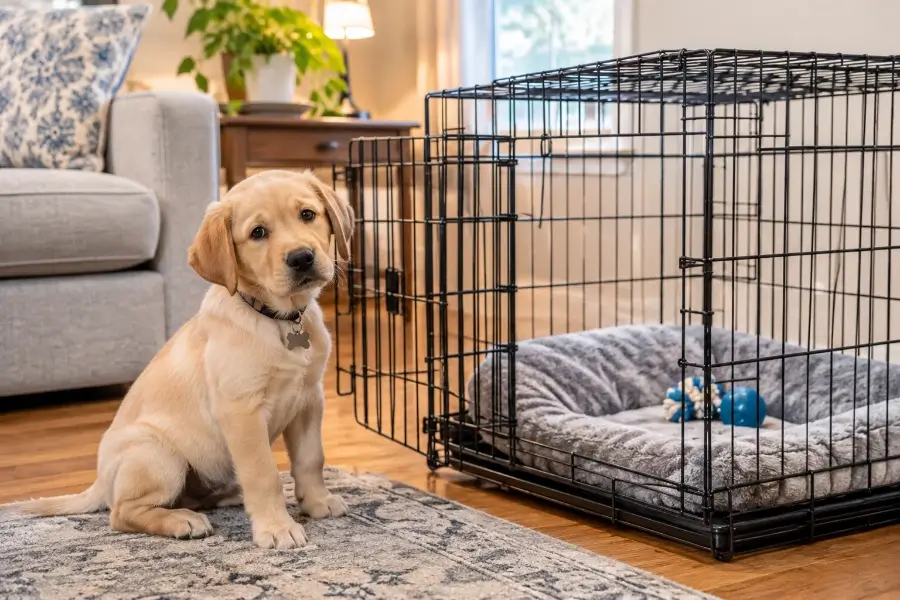
For most new puppies, a wire crate with a divider panel is the best choice. The divider lets you start with a small den-sized space and expand it as your puppy grows – without buying a second crate. The open sides make it easy to cover with a blanket, turning it into a cozy den environment that most puppies settle into faster.
What Size Crate Does a Puppy Need?
The correct size is just big enough for your puppy to stand up, turn around, and lie down comfortably – nothing more. If the crate is too large, your puppy may use the far corner as a bathroom, which completely defeats the purpose of crate training for house training.
| Adult Dog Size | Recommended Crate Size | Example Breeds |
|---|---|---|
| Small (up to 25 lbs) | 24 inches | Chihuahua, Maltese, Shih Tzu |
| Medium (25-50 lbs) | 30-36 inches | Cocker Spaniel, Beagle, Border Collie |
| Large (50-90 lbs) | 42 inches | Labrador, Golden Retriever, Husky |
| Extra Large (90+ lbs) | 48 inches | German Shepherd, Great Dane, Mastiff |
Buy the crate size for your dog’s adult weight, not his puppy weight. Then use the included divider panel to block off the back section until he grows into the full space. This saves you from buying multiple crates as your puppy grows.
What You Need Before You Start Crate Training
Your Crate Training Supplies Checklist
- The crate (correct size, with divider panel if wire)
- A Kong Classic – the single most important crate training tool you can buy. Fill with kibble and a little peanut butter, freeze overnight, give in the crate every time.
- High-value treats – small, soft treats your puppy goes crazy for. Used during the introduction steps.
- A lightweight blanket for covering three sides of a wire crate
- A worn t-shirt or article of clothing with your scent to place inside the crate
- A snuggle puppy or heartbeat toy (optional but very helpful for the first few nights)
- An Adaptil diffuser or collar (optional – synthetic calming pheromone, available at most pet stores)
Where to Put the Crate
Location matters. Put the crate in a room where your family spends time – the living room or bedroom works well. During the day, keep the crate in the main living area so your puppy does not feel isolated. At night, move the crate to your bedroom, ideally right next to your bed. This is not about spoiling your puppy. It is about reducing anxiety and hearing him when he needs a nighttime potty trip.
Once your puppy is fully trained and comfortable with the crate, you can move it to a permanent location if you prefer. During the training phase, proximity to you makes everything faster and less stressful.
How Long Can a Puppy Stay in a Crate? Age-by-Age Guide
This is the question most people get wrong. Many new puppy owners either crate too long (causing accidents and frustration) or not long enough (losing the housetraining benefit). Here is the guideline based on your puppy’s age:
| Puppy Age | Maximum Daytime Crate Time | Overnight |
|---|---|---|
| 8-10 weeks | 1 hour maximum | 3-4 hours (1 potty trip needed) |
| 11-14 weeks | 1-2 hours | 4-5 hours (1 potty trip needed) |
| 15-16 weeks | 2-3 hours | 5-6 hours (may need 1 trip) |
| 4-5 months | 3-4 hours | 6-7 hours |
| 6+ months | 4-5 hours maximum | 7-8 hours |
| Adult (1+ year) | 4-6 hours, up to 8 for trained adults | 8 hours |
These are maximum times, not targets. A general rule you will hear from most trainers: a puppy can hold his bladder approximately one hour per month of age, plus one. So a 2-month-old puppy can hold it for roughly 3 hours. A 3-month-old for roughly 4 hours. This is a rough guide – individual puppies vary. When in doubt, err on the side of shorter, not longer.
No puppy under 6 months should be crated for more than 3-4 hours at a stretch during the day. No dog of any age should be crated for more than 8 hours total in one day. These are not arbitrary limits – they come from what puppies physically need in terms of bathroom breaks, movement, and social interaction.
How to Crate Train a Puppy Step by Step
The biggest mistake new puppy owners make is rushing this process. Each step needs to become genuinely comfortable before you move to the next one. If your puppy is not ready for the next step, do not push forward – go back to the previous step and give it more time.
Step 1 – Set Up the Crate and Let Your Puppy Explore It
Put the crate in the room where your puppy will spend time. Leave the door open. Put a few treats just inside the entrance. Let your puppy go in and out freely. Do not close the door. Do not force him inside. The goal of this step is simply for your puppy to discover that the crate is not scary and that good things happen near it. This step takes anywhere from 10 minutes to a full day depending on your puppy’s personality.
Step 2 – Feed Meals Near, Then Inside, the Crate
Start feeding your puppy’s regular meals right next to the crate door. After a day or two, move the bowl just inside the entrance. Then a little further in. Then all the way to the back of the crate. At each stage, your puppy eats where you place the bowl. If at any point he refuses to go in or seems very hesitant, the bowl is too far inside – move it back to where he was comfortable and try again more slowly. By the end of this step, your puppy should be walking all the way into the crate to eat, with the door still open.
Step 3 – Close the Door for the First Time (While Your Puppy Eats)
Once your puppy is walking confidently into the crate for meals, close the door while he eats. Open it as soon as he finishes. Do not leave him in there after the meal is done. Just close it during eating, then open it immediately. After a few successful meals this way, leave the door closed for a minute or two after he finishes, then open it. Gradually extend this by a few minutes each time.
Step 4 – Introduce the Kong and a Cue Word
Now you are going to start using a cue word – something like “crate,” “kennel,” or “place.” Say your chosen cue word, toss a treat into the back of the crate, and when your puppy goes in, give him a frozen Kong. Close the door. Sit near the crate. After 5-10 minutes, open the door. Practice this multiple times per day. The Kong should last long enough to cover the time the door is closed. This step builds the association: cue word = crate = Kong = good things. This is the foundation everything else is built on.
Step 5 – Extend the Time, Then Leave the Room
Once your puppy goes into the crate willingly on the cue word and settles with the Kong, start extending the time the door is closed. Work up to 30 minutes with you sitting nearby. Then start leaving the room for short periods – go to the kitchen, come back, say nothing. Gradually extend to 10 minutes, 20 minutes, 30 minutes away. At this stage, your puppy is learning that you leaving is not a big deal and that you always come back.
Step 6 – Crate Your Puppy When You Leave the House
Once your puppy is comfortable with 30-45 minutes alone in the crate, you are ready to start using it for real departures. Keep your departure calm and low-key. Give the Kong, say the cue word, close the door, and leave without any big goodbye. When you return, let your puppy out quietly – no dramatic reunion. This keeps the whole experience calm and undramatic.
Step 7 – Overnight Crating
Move the crate next to your bed. Put a shirt with your scent inside. Give a frozen Kong at bedtime. When your puppy wakes and cries in the night (and he will, especially the first week), take him outside immediately and quietly for a potty trip, then put him directly back in the crate. Keep the overnight potty trip boring – no play, no lights, no talking. The message is: outside is for bathroom, crate is for sleeping. Most puppies make significant progress on overnight crating within 7-10 days.
Your Puppy’s First Night in the Crate – What to Expect
Night 1 Through Night 7 – What Is Normal
Honestly, the first night is usually rough. Your puppy just left his littermates and mother. He is in a new place with new smells and new sounds. Some crying and whining is completely normal and expected. Here is what most puppy owners experience:
- Night 1-2: More crying, possibly a lot. This is normal. Your puppy is adjusting to being alone and to his new environment. Keep the crate next to your bed. Many puppies settle faster knowing you are nearby.
- Night 3-4: Usually slightly better. Your puppy is starting to build a routine around the crate.
- Night 5-7: Most puppies are noticeably more settled by the end of the first week. Many start to put themselves into the crate at bedtime.
- Week 2 and beyond: Most puppies have significantly improved overnight behavior. By the end of the second week, many puppies sleep through most of the night with just one potty trip.
If your puppy is still crying intensely every night after two weeks, something needs to change. Check the crate size, the bedtime routine, the amount of exercise your puppy is getting, and whether the crate has been associated with enough positive experiences during the day.
Sample Daily Crate Schedule for an 8-Week-Old Puppy
Use this as a starting framework. Every puppy is different and your schedule will not match this exactly. The key patterns: potty trips happen immediately before and after every crate period, play and training happen when your puppy is out, and nap times are enforced with the crate whether your puppy seems tired or not.
| Time | Activity |
|---|---|
| 6:30 AM | Wake up, immediately outside for potty |
| 6:45 AM | Breakfast in or near crate |
| 7:00 AM | Short play and training session (10-15 min) |
| 7:30 AM | Outside for potty, then crate nap with Kong (1 hour) |
| 8:30 AM | Outside for potty |
| 9:00 AM | Supervised play, socialization, training |
| 10:00 AM | Outside for potty, then crate nap (1 hour) |
| 11:00 AM | Outside for potty |
| 11:15 AM | Supervised play, chew time |
| 12:00 PM | Lunch, crate nap (1 hour) |
| 1:00 PM | Outside for potty, play, training |
| 2:30 PM | Outside for potty, crate nap (1 hour) |
| 3:30 PM | Outside for potty, afternoon activity |
| 5:00 PM | Dinner |
| 5:30 PM | Outside for potty, evening play |
| 7:00 PM | Calm time, begin settling routine |
| 9:00 PM | Final potty trip, bedtime in crate |
| 12:00-1:00 AM | Overnight potty trip (set an alarm – do not wait for crying) |
Notice that potty trips happen on a schedule rather than waiting for your puppy to signal. At 8 weeks, puppies often do not signal in time. By being proactive, you prevent accidents before they happen instead of reacting to them after.
How to Handle Whining and Crying in the Crate
Protesting vs. Panicking – How to Tell the Difference
Not all crate crying is the same. Ohio State University’s veterinary program makes a useful distinction between a puppy who is protesting and one who is panicking.
Protesting looks like: whining, fussing, grumbling, occasional barking, trying to get your attention. The puppy is uncomfortable with being in the crate but is not in real distress. This is normal and expected during the training phase.
Panicking looks like: continuous frantic barking, throwing his body against the crate door, drooling, panting heavily, trying to dig or chew his way out, unable to settle even briefly. This is a stress response – not typical puppy fussing – and it needs a different approach entirely.
If your puppy is panicking, do not continue to confine him. That level of distress can lead to real physical injury. According to UC Davis School of Veterinary Medicine, anxious dogs attempting to escape crates risk broken teeth and torn nails – documented, real injuries. If your puppy panics consistently, talk to your vet before continuing crate training.
Cornell University’s Dr. Aly Cohen lists these as distress signals to watch for: excessive barking that does not stop, pacing, persistent panting, eliminating inside the crate despite having just gone outside, and excessive drooling. Any of these together suggests real distress, not just normal protest.
The 5-Minute Check – What Newer Research Suggests
Older advice told puppy owners to “let them cry it out” – leave the puppy to cry until they stop, no matter how long it takes. That approach is now being questioned by veterinary behaviorists and dog trainers. Newer thinking suggests there is no benefit in letting a young puppy cry for more than a few minutes without a brief check-in. Many experienced trainers now recommend going to check on your puppy after about 5 minutes if the crying is intense. This does not mean letting them out of the crate – it means letting them hear your voice or see you briefly, then stepping away again. The goal is to prevent the puppy from hitting a full panic spiral, not to reward the crying.
What Not to Do When Your Puppy Cries
- Do not let them out the moment they cry. This teaches them that crying opens the door. Wait for a pause – even a brief one – then open the door.
- Do not scold or yell at your puppy for crying. This creates fear and confusion, not compliance.
- Do not make a dramatic entrance when you go back in. Keep arrivals quiet and low-energy.
- Do not console excessive crying with long petting sessions through the crate bars. Brief reassurance is fine. Extended soothing can signal to a young puppy that something scary is actually happening.
- Do not reward whining with treats. UC Davis specifically notes that both rewarding and scolding the crying teach the wrong lesson.
Common Crate Training Mistakes to Avoid
- Rushing the introduction. Skipping the gradual positive steps is the number one cause of ongoing crate problems. Each stage needs time to become comfortable before moving forward.
- Using the crate as punishment. The moment you say “bad dog, go to your crate,” you have damaged weeks of positive training. Never use the crate as a time-out or penalty.
- Crating too long. Accidents inside the crate are almost always a sign that your puppy was left in too long, not a behavior problem. Go back to your age-based time limits.
- Wrong crate size. Too big means your puppy can use the back corner as a bathroom. Use the divider panel until your puppy is fully housetrained.
- Dramatic departures and arrivals. Big emotional goodbyes and excited hellos teach your puppy that your departure is a huge, significant event worth getting upset about.
- Leaving the collar on. Collars can catch on wire bars and cause serious injury. Remove it every single time.
- Not covering a wire crate. An open wire crate feels like a fish tank, not a den. Cover three sides with a blanket and watch how much faster your puppy settles.
- Adding bedding too soon. Wait until your puppy is fully accident-free in the crate before adding a plush bed. A soiled bed becomes a mess that is hard to clean and teaches the wrong lesson about where to eliminate.
- Skipping the Kong. A crate with nothing interesting in it is just a box. A frozen Kong stuffed with kibble gives your puppy a job to do and something to look forward to.
Troubleshooting – When Crate Training Goes Wrong
My Puppy Was Doing Great and Now Hates the Crate Again
Regressions are normal and common. Something changed – your schedule shifted, the puppy had a scary experience in or near the crate, you pushed too fast too soon, or your puppy hit a fear period (which puppies typically go through around 8-11 weeks and again at 6-14 months). When this happens, go back to basics without treating it like a failure. Start from the beginning of the introduction steps. Make the crate more appealing again with new treats and a shirt with your scent inside. Check whether the crate size is still right for a growing puppy.
Separation Anxiety vs. Crate Anxiety – What Is the Difference?
Crate anxiety means your dog is upset about the crate specifically. The fix is more gradual desensitization and positive conditioning to the crate itself. These dogs are usually fine when loose in the house or in another room.
Separation anxiety means your dog is upset about being away from you, regardless of where they are. These dogs panic in a crate, but they also panic if gated in a room or even left alone in an open space. Using a crate to manage separation anxiety does not fix the underlying problem. According to UC Davis School of Veterinary Medicine, a crate may prevent destruction but it is unlikely to reduce the anxiety and can actually make it worse. These dogs need a veterinary evaluation and possibly work with a certified animal behaviorist (CAAB or IAABC certified).
Crate Training in an Apartment – The Neighbor Noise Problem
- Talk to your neighbors proactively before or right after you bring your puppy home.
- Play soft talk radio or audiobooks near the crate – this works better than music for masking external sounds and providing calming background noise.
- Try an Adaptil diffuser or spray near the crate area. Adaptil is a synthetic version of the dog-appeasing pheromone that mother dogs release. Many owners report it makes a noticeable difference in the first few weeks.
- Tire your puppy out before bed – a walk, a play session, some training. A tired puppy settles much faster and sleeps longer.
- Consider a white noise machine if your apartment has thin walls and outside noise that wakes your puppy at night.
Crate Training When You Work Full-Time
- Use a large exercise pen or puppy-proofed room with pee pads during work hours. Use the crate for naps and bedtime when you are home.
- Hire a dog walker or puppy sitter to come at midday – roughly 2-3 hours into your workday.
- Consider puppy daycare 2-3 days per week.
- Work from home temporarily if possible, especially for the first 2 weeks.
- Interestingly, working from home all day can sometimes be harder for puppies – the puppy never learns to settle because you keep interacting with him. A puppy who goes to daycare a few days a week sometimes develops better rest habits than one who is home all day with a remote-working owner.
Special Situations Worth Knowing About
Crate Training a Rescue Dog or Rehomed Adult Dog
Rescue dogs may have no crate experience, or they may have had bad crate experiences in a shelter or previous home. Start from zero regardless of what the rescue tells you. Go through the same gradual introduction steps you would use with a puppy – often over a longer period. Use very high-value treats (chicken, cheese, hot dogs). Take it slow. If a rescue dog shows signs of significant fear around the crate – hiding, shaking, drooling, refusing to go near it even for food – consult your vet before pushing forward. Some rescue dogs do much better with a pen-and-crate combination than with a crate alone.
Two Puppies at the Same Time – The Littermate Syndrome Warning
Getting two puppies from the same litter at the same time seems like a great idea – they can keep each other company, right? In practice, it often creates something called littermate syndrome, where the puppies bond so intensely to each other that they fail to bond properly to humans, cannot function independently, and develop extreme anxiety when separated. If you have two puppies, train them separately and crate them separately. Each puppy needs its own crate and its own crate training process. This is not optional – it is essential for raising two dogs who are actually well-adjusted as individuals.
Overtired Puppies – The Hidden Cause of Crate Resistance
Puppies need 18-20 hours of sleep per day. When puppies are overtired, they behave worse, not better. An overtired puppy is more likely to whine, bite, do zoomies, and refuse to settle in the crate. If your puppy is biting, running circles, barking, or refusing to calm down at crate time, your first thought should be “is this puppy overtired?” Before trying to do more training, put your puppy in the crate for a forced nap. A quick test: ask your overtired-seeming puppy to sit. If he cannot respond to a command he knows well, he is too tired to learn anything and needs to sleep, not train.
When to Stop Crating – Signs Your Dog Is Ready for More Freedom
There is no universal age for stopping crate use. The signs are behavioral, not chronological:
- Your dog has been fully house-trained for at least 2-3 months with zero accidents
- Your dog is not destructive when unsupervised for short periods
- Your dog is at least 12-18 months old (most chewing and destructive phases peak around 6-12 months)
- Your dog is calm and not showing anxiety signs when alone
When you are ready to test it, do it gradually. Start by leaving your dog loose in one room while you go out for 15-30 minutes. Work up slowly over several weeks. If you come home to any destruction or accidents, your dog is not ready yet – go back to the crate and try again in a few months.
Many dogs thrive with crate access throughout their lives even after the training phase ends. Leave the crate available with the door open and many dogs will choose to sleep in it voluntarily. It becomes their space in the house – which is exactly what you wanted from the start.
Frequently Asked Questions About Crate Training a Puppy
How long does it take to crate train a puppy?
Most puppies make noticeable progress within 1-2 weeks of consistent training. Many owners report their puppies were comfortable with 2-3 hour crate stretches within about a week. Full overnight training typically takes 2-4 weeks. However, some puppies – especially those with more anxious temperaments or high-energy breeds – can take 2-3 months. Both ends of that range are completely normal. The key variable is consistency: puppies who get the same routine every day progress faster than those with an inconsistent schedule.
Should I put a puppy in a crate at night?
Yes, crating at night is recommended during the house-training phase. It prevents accidents, keeps your puppy safe from nighttime hazards, and reinforces the crate as a resting space. Place the crate next to your bed so your puppy can hear and smell you. Most puppies need 1-2 overnight potty trips during the first few weeks – set an alarm and take them out proactively rather than waiting for them to cry.
Can a crate make separation anxiety worse?
Yes, it can. Using a crate to confine a dog with true separation anxiety may prevent destruction, but it does not treat the anxiety – and it can make the anxiety more intense by adding the stress of confinement on top of the stress of being alone. UC Davis School of Veterinary Medicine specifically states this. If you suspect your dog has separation anxiety rather than typical puppy fussing, talk to your vet before continuing crate training.
What do I do if my puppy cries all night in the crate?
Make sure the crate is next to your bed and covered on three sides. Give your puppy a frozen Kong and a shirt with your scent inside the crate. Take them outside for a full potty trip right before bedtime. Try a snuggle puppy or heartbeat toy. Consider an Adaptil diffuser. For the first few nights, some crying is normal and will decrease with consistency. If crying is intense and constant on night 4 or later, re-evaluate: check the crate size, the bedtime routine, and whether your puppy had enough exercise during the day.
Is it okay to cover a dog crate?
Yes, and for wire crates, it is actually recommended. Cover three sides with a lightweight blanket or crate cover, leaving one or two sides open for airflow. This creates a den-like environment that helps most dogs feel more secure and settle faster. Dr. Aly Cohen at Cornell University’s Riney Canine Health Center specifically recommends this technique.
How do I get my puppy to stop whining in the crate?
Only open the crate door when your puppy is quiet, even for just a second or two. Wait for a brief pause in the crying, then open the door. This teaches your puppy that quiet is what opens the door, not noise. Also make sure the crate is the right size (not too large), properly covered on three sides, located near you, and stocked with something engaging like a frozen Kong.
What can I put in a crate to keep a puppy busy?
A frozen Kong stuffed with your puppy’s regular kibble mixed with a bit of peanut butter or plain pumpkin is the gold standard. Freeze it overnight and give it when your puppy goes in the crate. Lick mats work well too. Bully sticks are good for young puppies who need something to chew. Avoid antlers, Yak cheese chews, and other very hard chews for puppies – they can crack teeth. A simple test: if you cannot dent it with your thumbnail, it is too hard for a puppy under 6 months.
Can I crate train a puppy while working full time?
Yes, but not by crating your puppy all day. Young puppies need bathroom access every 1-3 hours during the day. The practical solution is to use a playpen or puppy-safe room with pee pads during work hours, with a midday dog walker visit if possible. Use the crate for naps and nighttime while you are home. As your puppy’s bladder capacity grows with age, you can transition to longer daytime crate stretches.
Sources
- Cornell University College of Veterinary Medicine – Riney Canine Health Center, Dr. Aly Cohen, DVM
- UC Davis School of Veterinary Medicine – Veterinary Medicine Teaching Hospital
- Ohio State University Veterinary Medical Center – Companion Animal Behavior Resources
- American Kennel Club (AKC) – Breed Standards and Puppy Training Resources